Hybrid Workflow
3 curated items · 1 result figure
These notebooks demonstrate how you can apply hybrid solvers to your problem, create hybrid workflows, and develop custom hybrid components. Notebook 01 will start you off with Leap's cloud-based hybrid solvers and out-of-the-box dwave-hybrid samplers and workflows, and requires only familiarity with the binary quadratic model (BQM) approach to formulating problems for solution on quantum computers. Notebook 02 shows how you create your own workflows using existing dwave-hybrid components. Notebook 03 is aimed at developers interested in developing their own hybrid components for optimal performance.
Knapsack DQM
1 curated item · 1 result figure
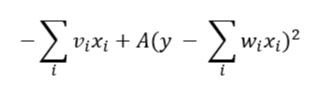
The knapsack problem is a common optimization problem. In it, we have a knapsack or some form of container and a list of items as well as their weights and values. The knapsack has a maximum weight which it can carry. The goal is to maximize the total value of the items placed into the knapsack without going over the weight limit. There are many different variations of the problem. In our version, there was a list of items with their associated weights and costs as well as the integer quantity of each available item.
The knapsack problem is an especially common and useful optimization problem, so there exists a lot of benefit if it could be run with a quantum speedup. We were very excited to try out implementing the problem on this new technology. Using the DQM solver was useful to discretize the variables in order to determine what quantity of each item to take.
To run a demo, run the command
where small.csv can be changed for very_small.csv or large.csv and 50 is the weight maximum.
Sudoku
1 curated item
Workflow Optimization
2 curated items
Building a schedule for employees can be an extremely complex optimization problem in which managers must balance employee preferences against schedule requirements. In this example, we show how a discrete quadratic model (DQM) and a constrained quadratic model (CQM) can be used to model this problem and how the hybrid solvers available in Leap can optimize over these competing scheduling and preference needs.
Usage
To run the CQM demo, type the command:
Type the number of employees to be considered and hit Enter. Note that the CQM solver can take up to 5000 variables, or employees for this problem.
A second prompt for the number of shifts will appear: