Quantum Games
6 curated items · 14 result figures
A fun way to learn about quantum circuits.
<h2 align="center"><img src="https://github.com/MonitSharma/qiskit-projects/blob/main/Quantum_Game/find_the_impostor/puppyy3533amoung-us-puppyy-kitchen-pantry-amoung-us-impostor.gif">
Motivation
The science of quantum computing has recently experienced tremendous growth and continues to draw people of all ages. Students were interested in quantum computing at an ever-earlier age after first hearing about it. However, young students have a harder time comprehending the mechanism or approach of quantum algorithms than classical ones due to the complexity of the field. In order to provide young pupils with an interactive platform for implementing circuits, the Quantum game was created. To replicate four vents with their four states in superposition, the game needs two qubits. The likelihood of discovering the impostor in the corresponding vent is indicated and represented by the amplitude of each state. I…
How to Play?






Removing Slack Variables
6 curated items · 26 result figures
The problem
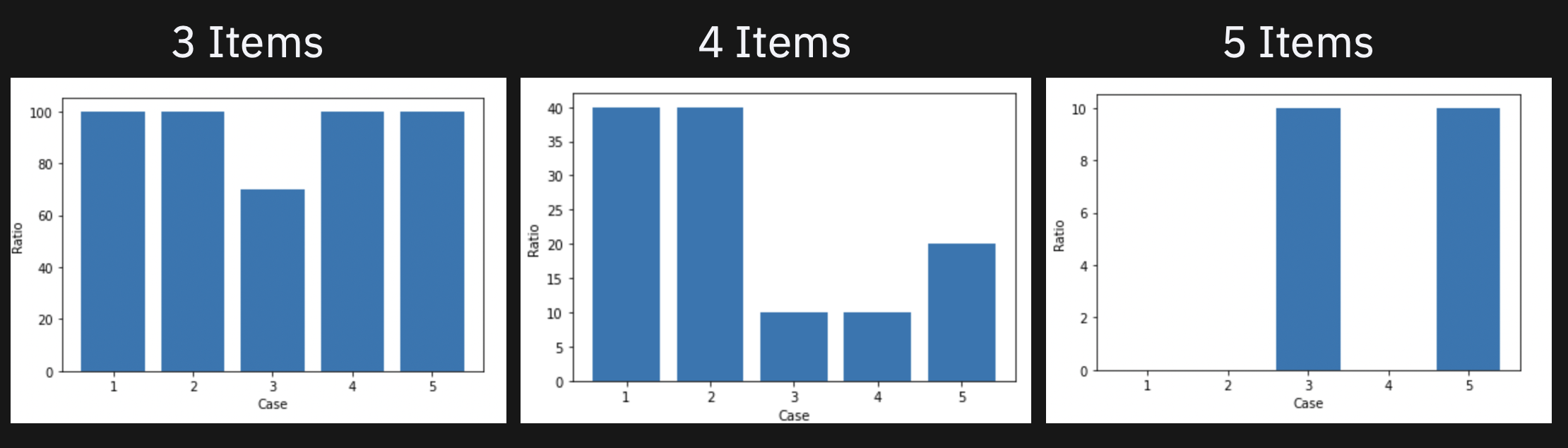
Different optimization problems suited for being solved by quantum computers (QC) have inequality constraints that make a first approach of solving them really difficult for our current noise intermediate-scale quantum (NISQ) technology. This is because, the inequality constraints have to be converted into equality constraints and then, converted to binary representation and being solved with quadratic penalizations. The extra qubits added by these transformations and the resulting equation give us the motivation for looking at alternatives to get rid of the inequality constraints keeping the number of qubits constant. We will use the bin packing problem to test our alternative to the commonly used converter of…
Bin Packing Problem
The bin packing problem is an optimization problem where given a number of items with an assigned weight, we look at the best way to group the items minimizing the number of bins or containers needed to store them. The restriction, in this case, is the capacity of the bins which cannot surpass a certain weight. This problem has many real applications in areas as loading trucks with a weight restriction, filling up containers, and FPGA semiconductors chip design.
In terms of complexity, the bin packing problem is an NP-hard problem. However, there are efficient algorithms that allow the arrangement of a large number of items. One of them is the first fit, which provides a fast but not optimal solution to the problem.





Time Crystalline Eigenstate Order On A Quantum Processor
3 curated items
Abstract
Quantum many-body systems display rich phase structure in their low-temperature equilibrium states. However, much of nature is not in thermal equilibrium. Remarkably, it was recently predicted that out-of-equilibrium systems can exhibit novel dynamical phases that may otherwise be forbidden by equilibrium thermodynamics, a paradigmatic example being the discrete time crystal (DTC). Concretely, dynamical phases can be defined in periodically driven many-body-localized (MBL) systems via the concept of eigenstate order. In eigenstate-ordered MBL phases, the entire many-body spectrum exhibits quantum correlations and long-range order, with characteristic signatures in late-time dynamics from all initial states. It …
Here we have an implementation of Google Quantum AIs method for preparing and analyzing discrete time crystals on a quantum computer.
The original research paper can be found at : https://arxiv.org/pdf/2107.13571.pdf
TSP On Actual Hardware
1 curated item