← All projectsProject 08 / 12 · challenge

Classiq challenge / Circuit design

A logo.
A phase.
111 layers.

An 18-qubit phase oracle exploiting the structure of a 64 × 64 logo, with exhaustive numerical verification.

The final circuit ↗

Circuit depth

5,329111

≈48× shallower
18 qubits · 557 CX gates

Exploit the image structure

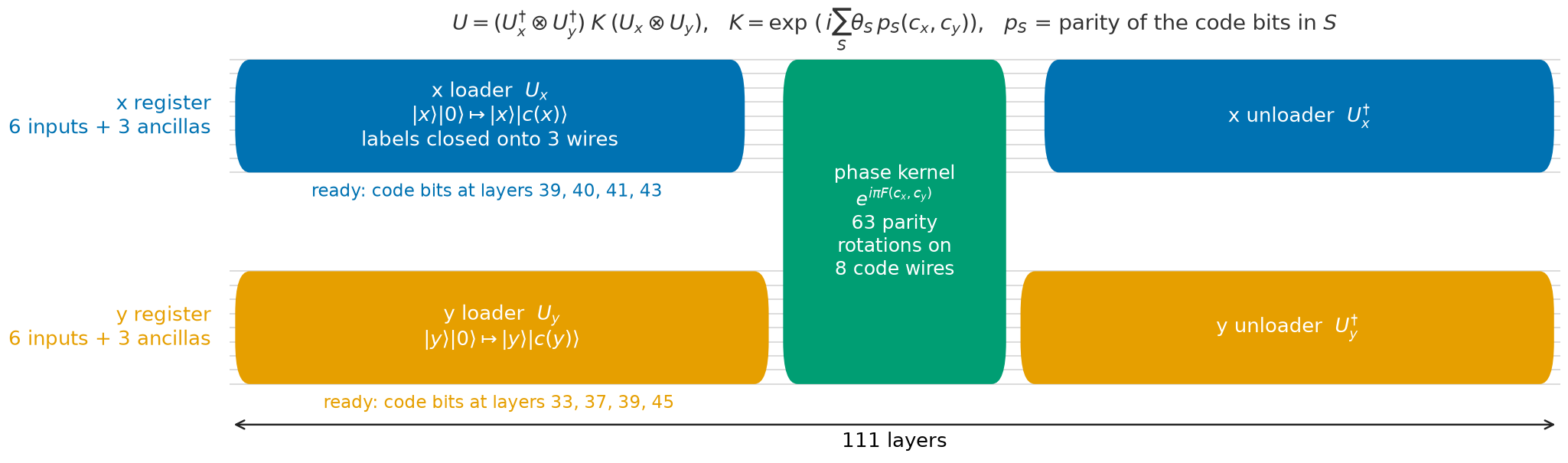
Load. Phase. Uncompute.

64 × 64 pixels
Class-code loaders, phase polynomial, and uncomputation

Class-code loaders, phase polynomial, and uncomputation

The pipeline makes the load–phase–uncompute structure explicit. Cleaning the ancillary register is part of implementing the intended oracle.

11

distinct row and column patterns, each represented by a four-bit class code. Repetition in the image becomes structure in the circuit.

Every layer counts.

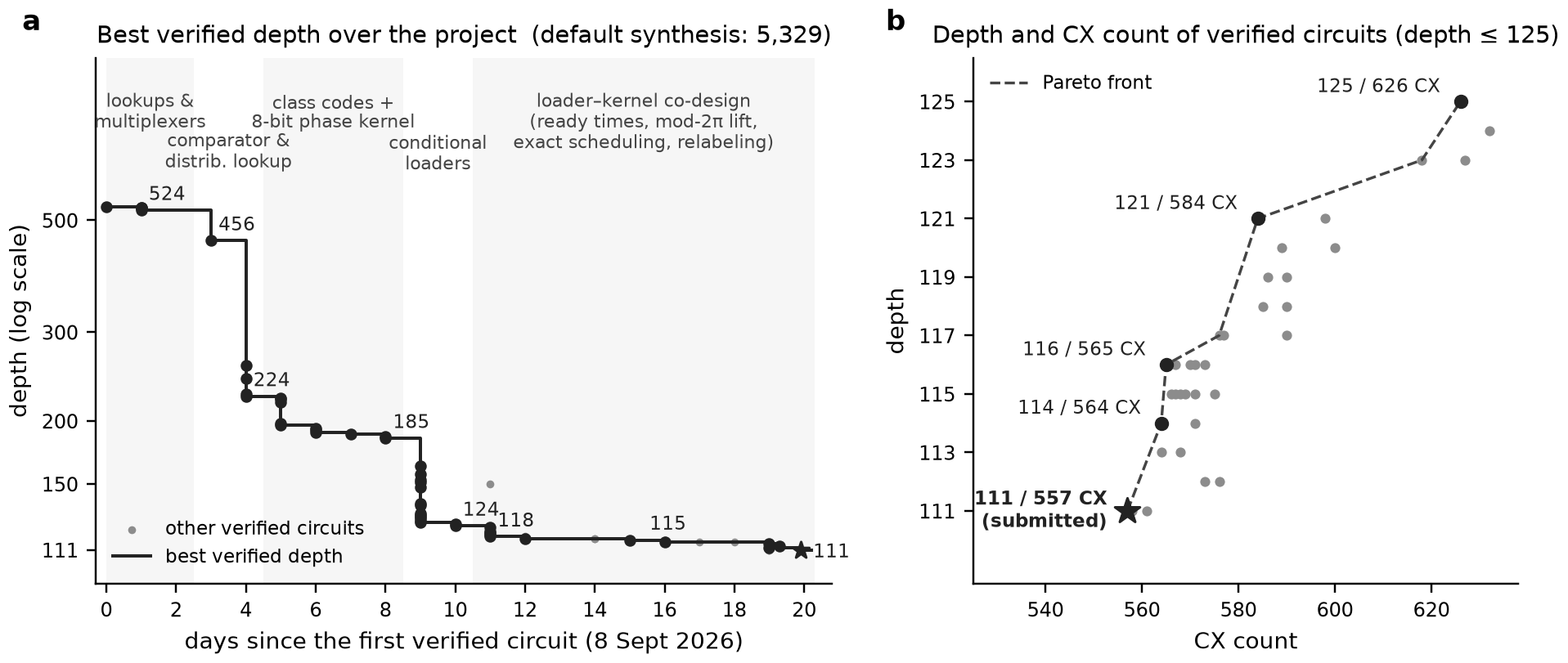
Depth and gate-count optimization history

Depth and gate-count optimization history

The optimization history shows depth and gate count changing together. The final depth of 111 is a completed construction, not a proof that shallower circuits are impossible.

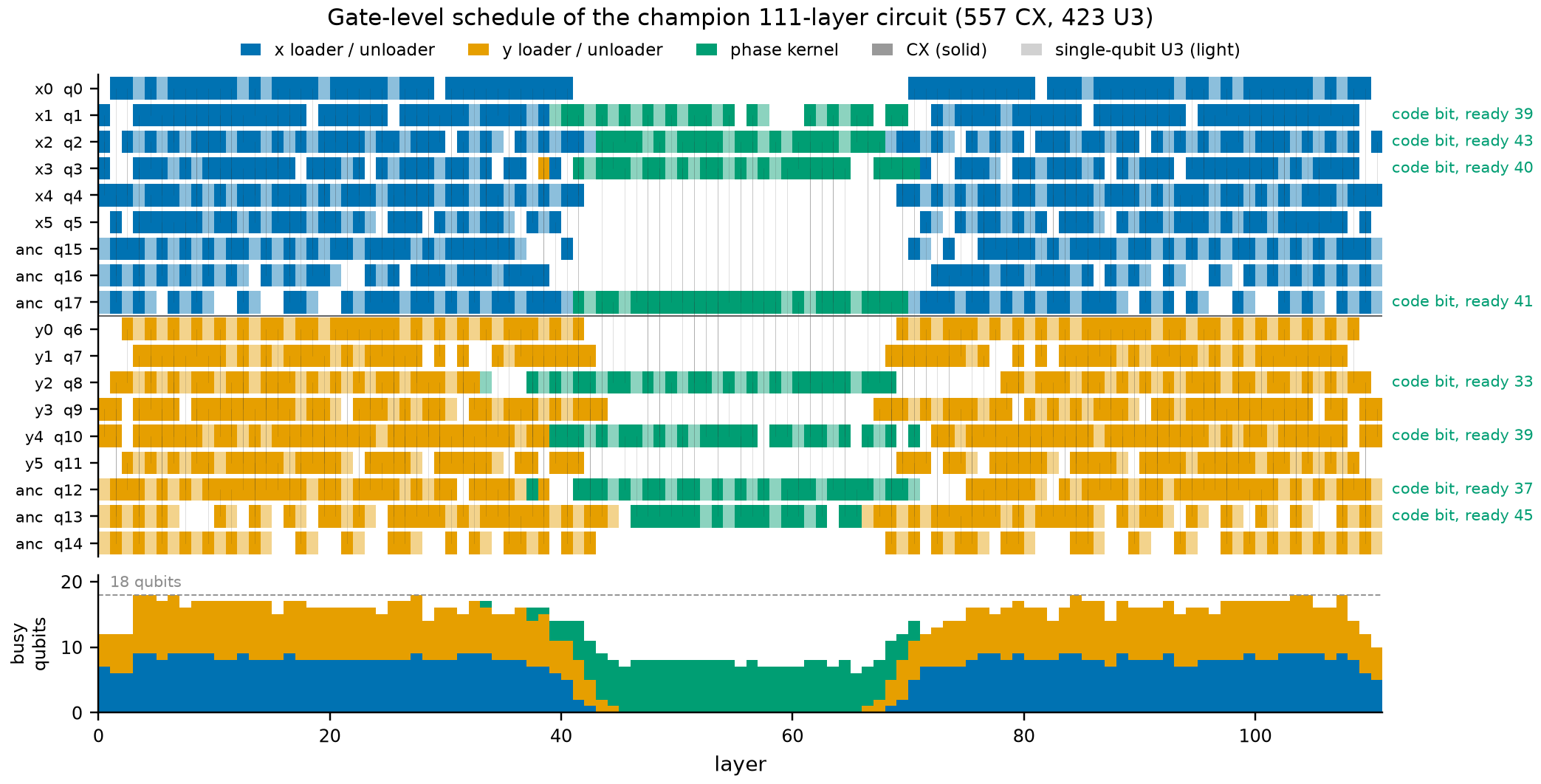
Ready-time circuit scheduling

Ready-time circuit scheduling

The schedule shows how operations are arranged around dependency and ready-time constraints. This is why two circuits with similar gate counts can have different depths.

Final submission compared with the starting construction
MeasurementBaselineFinal
Circuit depth5,329111
CX gates3,502557
Verified inputs—4,096 / 4,096

Exhaustively verified

4,096 / 4,096

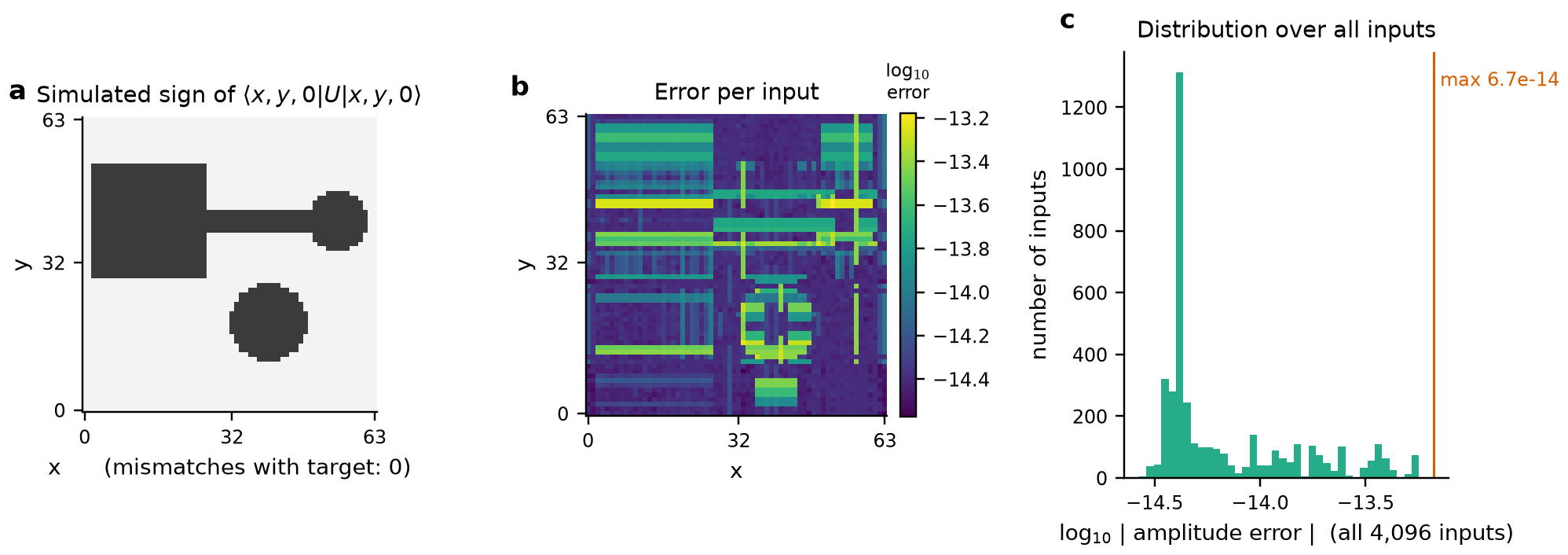
Class-code loaders, a 63-term phase polynomial, and ready-time scheduling reduced the circuit to depth 111, with 557 CX and 423 U3 gates. All 4,096 valid inputs passed verification; six ancillas returned to zero. The largest numerical error was 5.57×10⁻¹⁴. Depth 111 is the best completed construction here, not a general lower bound.

Exhaustive phase-oracle verification

Exhaustive phase-oracle verification

Verification covers all valid inputs and checks both phase behavior and ancillary cleanup. The reported numerical error is measured up to a common global phase.

Class codes, phase polynomials & ready-time scheduling

Using the logo’s structure

The oracle must assign the required phase to each of the 4,096 pixels of a 64 × 64 image while cleaning up its work qubits. Rather than treating every pixel independently, the construction uses the repeated row and column patterns: 11 classes can each be represented by a four-bit code. This reduces the structure that the central phase operation has to encode.

Optimizing the interfaces as well as the gates

The circuit loads class codes, applies a 63-term phase polynomial, and reverses the loading computation. Gate count alone does not determine depth: the arrival time of each signal and the dependencies between operations also affect the schedule. Ready-time scheduling and loader/phase interfaces therefore form part of the optimization, followed by exhaustive verification of the completed circuit.

Implementation & checks

  1. Compress 11 distinct row and column patterns into four-bit class codes.
  2. Load the class codes, apply a 63-term phase polynomial, then uncompute the loaders.
  3. Use ready-time scheduling and interface optimization to reduce depth; verify the final 18-qubit U3/CX construction exhaustively.