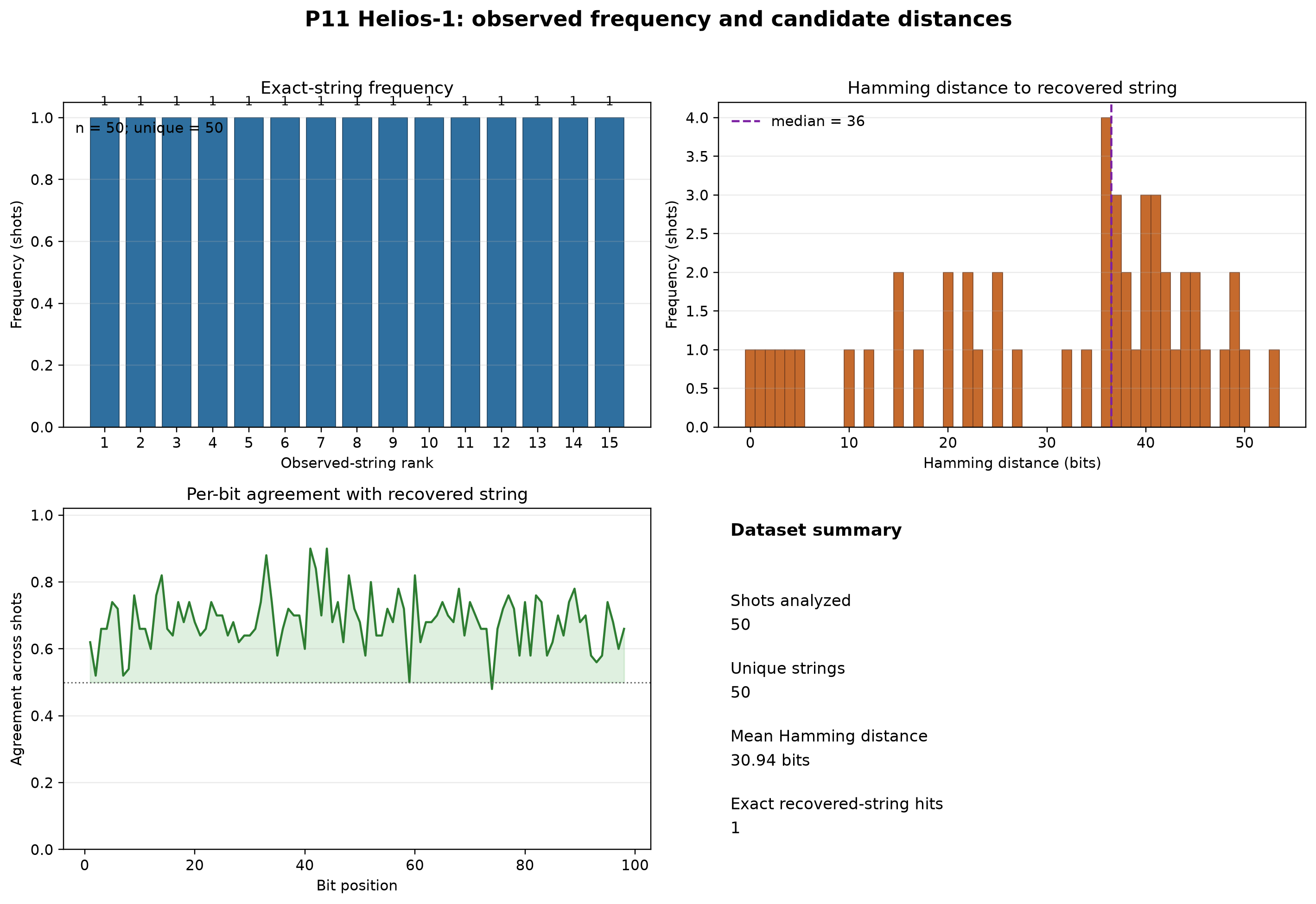
P11’s 50 corrected shots include a broad distribution of exact strings. Frequency, Hamming distance, and per-bit agreement reveal the structure used by the target-blind decoders.
Accepted recovery
P12
Qubits
98
Analyzed shots
200
Hardware cost
1,373.4 HQC
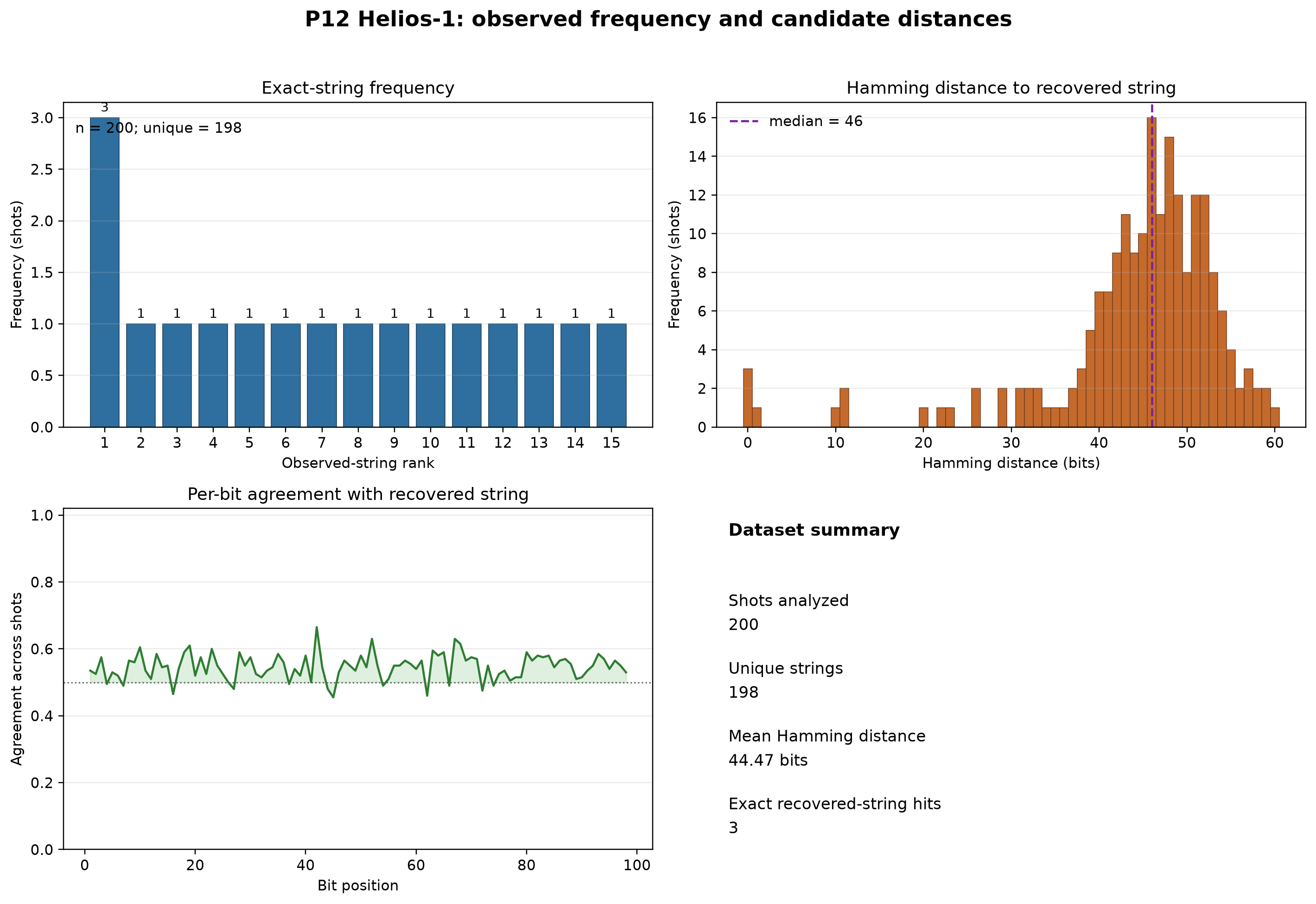
P12 used 200 reconstructed shots and 1,373.4 HQC. The most frequent string, weighted medoid, and cluster consensus agreed.
P12 uses 200 reconstructed shots after structural overlap repair. The frequency view and bitwise agreement complement the agreement between the most frequent string, medoid, and cluster consensus.
The recovery pipeline
From hardware output to an accepted bitstring.
01
Preserve raw provider output and metadata. Repair structural duplicate framing: one duplicate in P11 and five overlap replicas in P12.
02
Canonicalize every valid 98-bit shot. No candidate-based or hidden-answer-based shot filtering is used.
03
Run target-blind weighted-medoid and cluster-consensus decoding, then retain candidates, reports, figures, and SHA256 manifests.
The leaderboard records rank #1 and 2570/2570. It corroborates the accepted hackathon submissions but does not attribute individual points to P11 or P12.
Decoding & provider framing details +
Recovering a center from noisy samples
A peaked circuit concentrates its ideal output near a particular bitstring. Hardware noise spreads the observations into a cloud of nearby strings, so the most frequent exact sample may be an incomplete description. The weighted observed medoid selects an actual sample that minimizes total Hamming distance to the complete distribution; cluster consensus estimates the common bit at each position in the dominant group.
Keeping repairs separate from decoding
Provider framing problems are addressed before candidate recovery. The original output is preserved, structural duplicates are documented, and all corrected valid shots enter the analysis. This separation matters: repairing repeated output segments is different from discarding shots because they disagree with a desired answer. The P11 and P12 packages retain enough intermediate evidence to audit that distinction offline.
Implementation & checks
Preserve raw provider output and metadata. Repair structural duplicate framing: one duplicate in P11 and five overlap replicas in P12.
Canonicalize every valid 98-bit shot. No candidate-based or hidden-answer-based shot filtering is used.
Run target-blind weighted-medoid and cluster-consensus decoding, then retain candidates, reports, figures, and SHA256 manifests.