Computational chemistry / Research notes2Fe–2S cluster
Classical references for quantum chemistry
Strong correlation. A careful reference.
Quantum Chemistry
ABSTRACT
In iron–sulfur clusters the electrons interact so strongly that standard approximations struggle, which is why molecules like this are popular test cases for quantum algorithms. But to know whether a quantum method actually helps, you first need a trustworthy classical answer to compare against. This project builds that reference and checks it from several independent directions.
30electrons
20spatial orbitals
240Mfixed-spin determinants
The checked Davidson reference
−116.605609120429 Eh
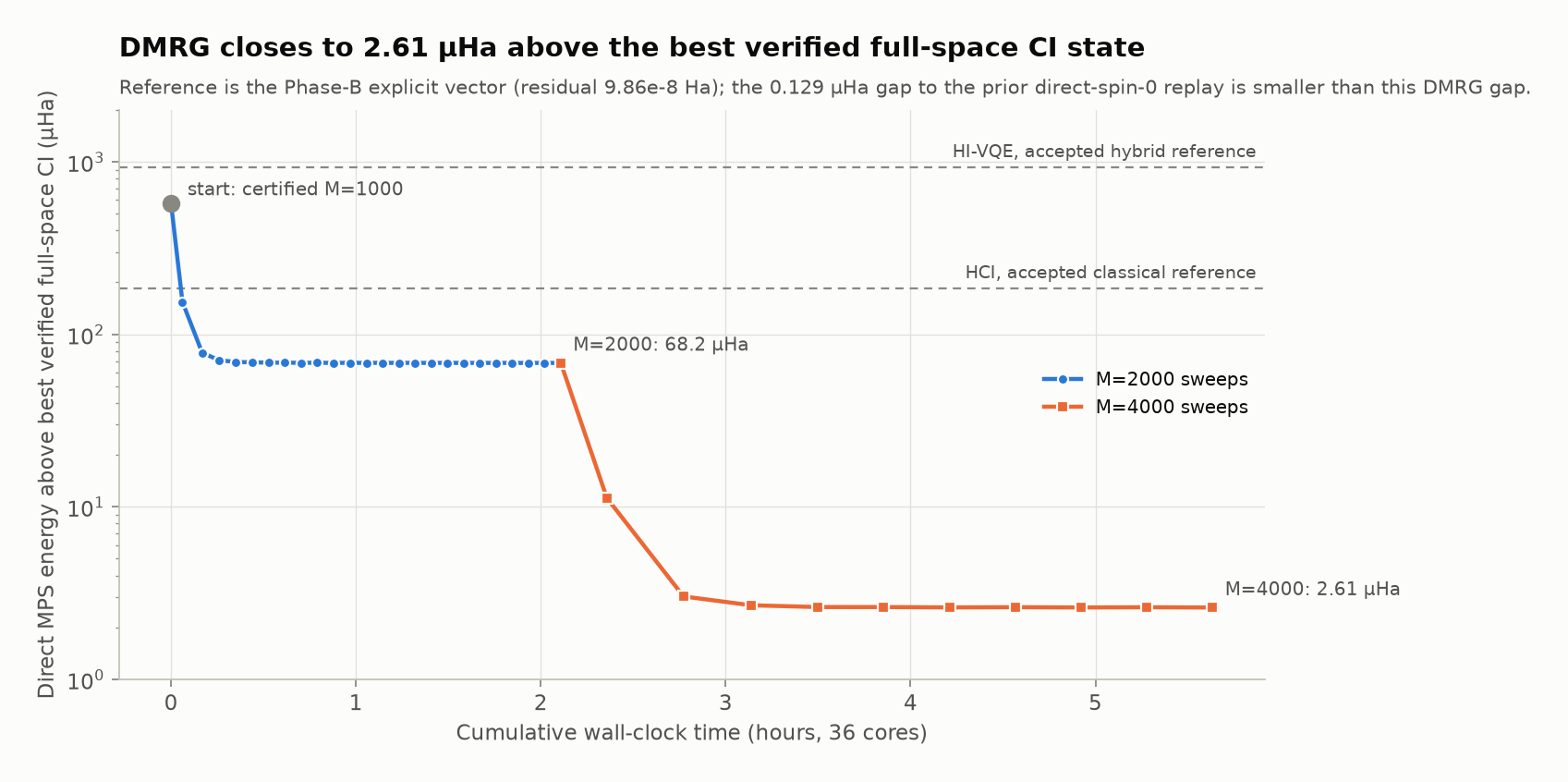
The checked full-space Davidson state reaches −116.605609120429 Eh, with residual 9.86×10⁻⁸ Eh. Block2 DMRG at M=4000 is 2.607 µEh above that state. The Davidson value is a one-sided variational upper bound; the residual target was not reached. Tested quantum proposals have not demonstrated an advantage over matched classical controls.
The energy landscape
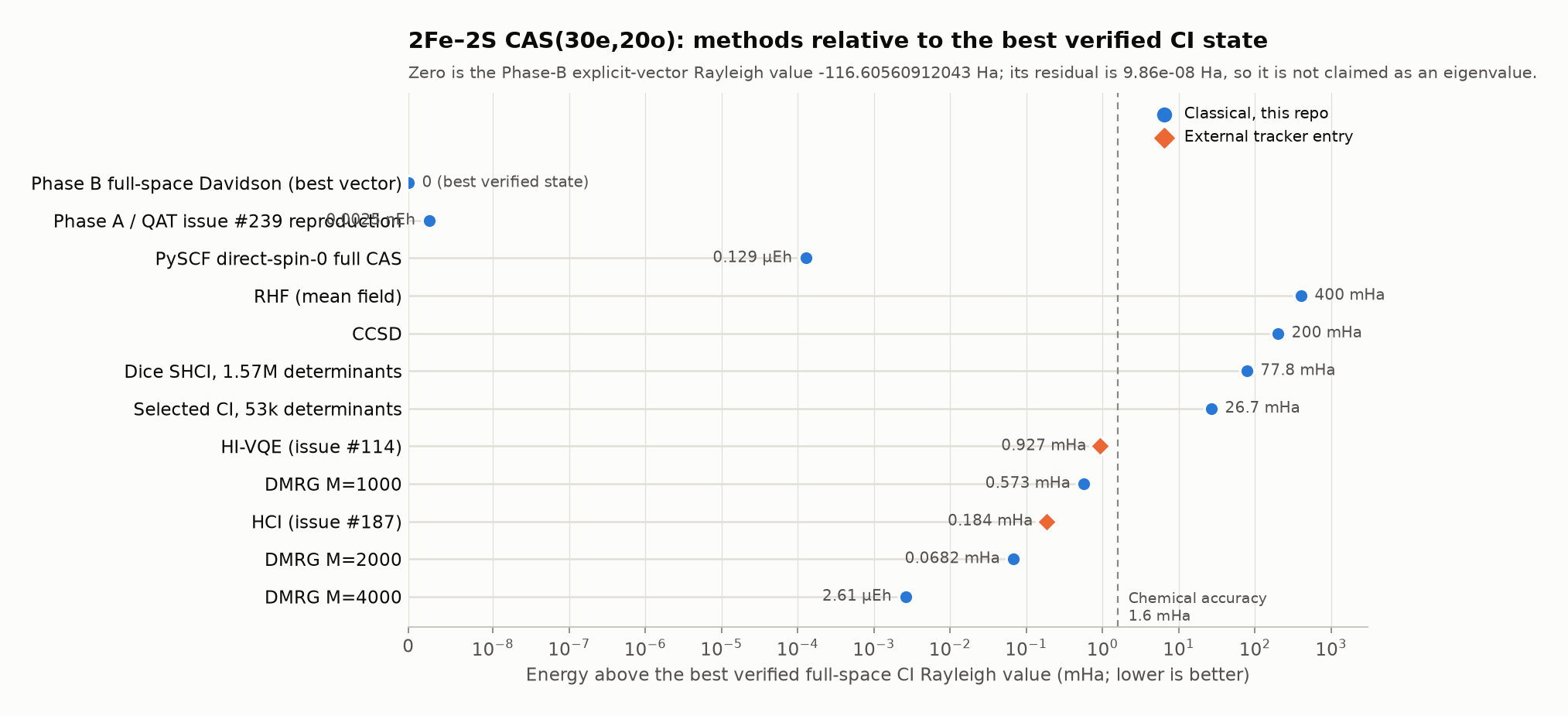
Comparing variational states and reported hybrid baselines in the same active space.
Checked classical states and reported hybrid baselines
The energy ladder puts the gaps on a common scale. The external HCI and HI-VQE entries are reported baselines, while the Davidson state was explicitly rechecked in this work.
Energy gap relative to the checked Phase B Davidson state
State
Energy (Eh)
Gap (µEh)
Davidson Phase B
−116.60560912042881
0
DMRG M=4000
−116.60560651330825
2.607
DMRG M=2000
−116.60554090347244
68.217
External HCI / QAT #187
−116.605425
184.120
External HI-VQE / QAT #114
−116.6046821
927.020
Convergence & independent checks
Energy alone is not enough.
The checked full-space Davidson state reaches −116.60560912042881 Eh with residual 9.8649×10⁻⁸ Eh.
The state spans CAS(30e,20o): 40 spin orbitals and 240,374,016 fixed-spin determinants.
Direct and reduced-density-matrix energy evaluations agree to 3.98×10⁻¹³ Eh; the checked spin expectation is approximately 5.96×10⁻¹¹.
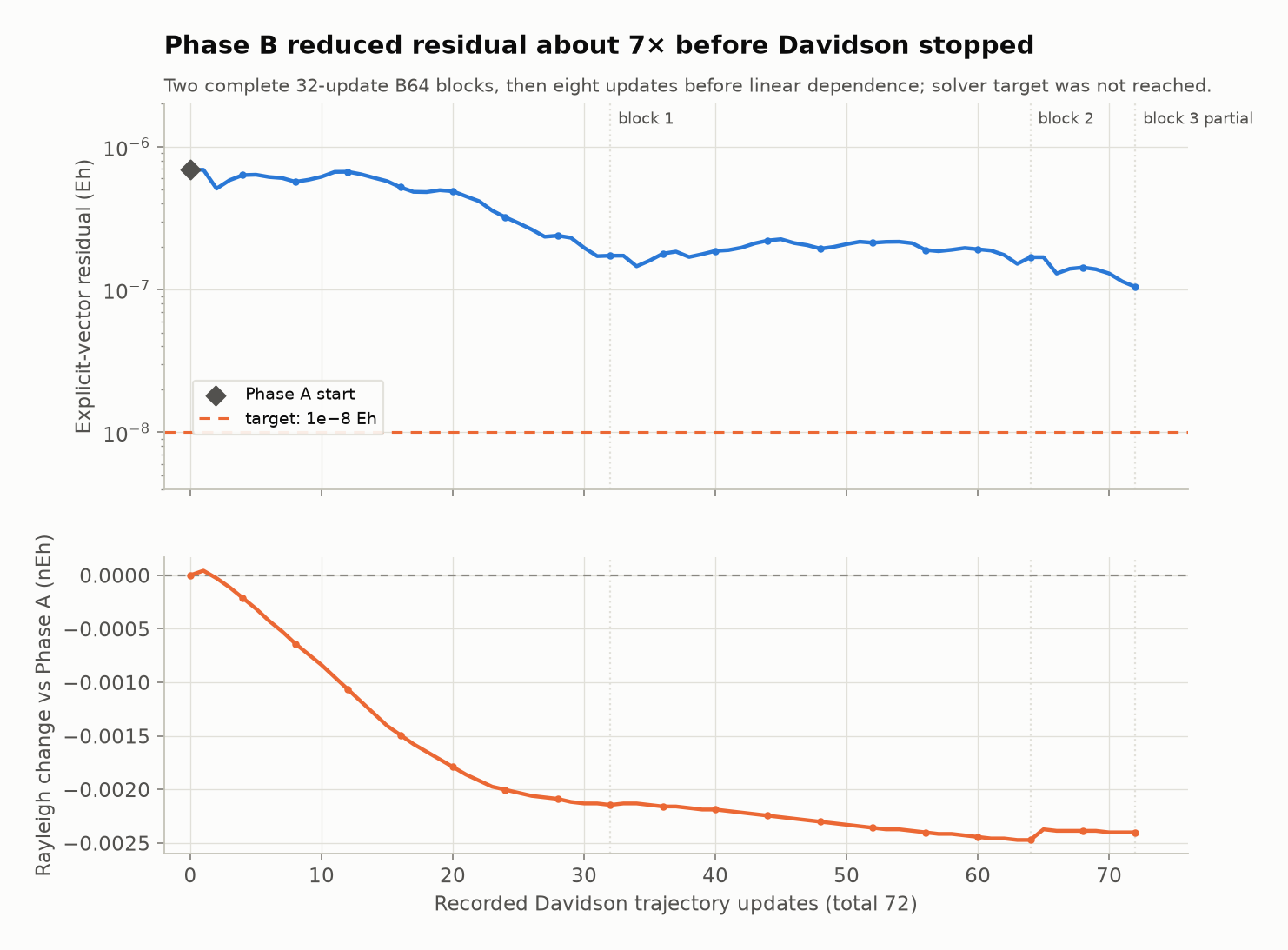
The residual tracks eigenstate quality during the Phase B refinement. Its final value remains above the requested tolerance even though the energy changes very little.
Convergence relative to the final checked reference
This view resolves the small changes near the final reference energy. Use it alongside the residual rather than interpreting a flat energy trace as proof of convergence.
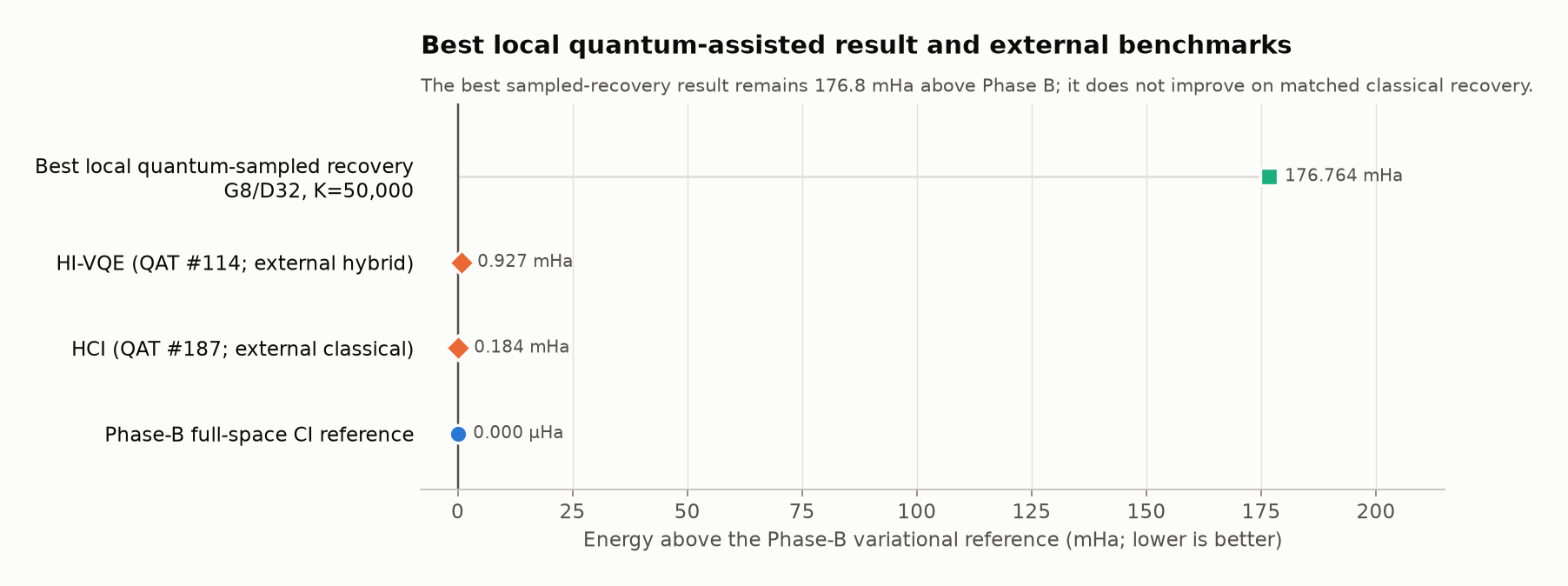
Quantum proposals compared with classical controls
The quantum-proposal comparison is read against matched classical controls. The tested proposals have not established an advantage under those comparisons.
Computational methods & residual checks +
Why this cluster is a demanding benchmark
Iron–sulfur clusters contain strongly interacting electrons, making them useful tests of electronic-structure methods. Here the active space contains 30 electrons in 20 spatial orbitals. Even after fixing the spin sector, the explicit determinant space contains more than 240 million states, so both numerical correctness and computational resources matter.
Energy alone is not enough
A variational energy gives an upper bound, but a very small energy change does not guarantee that an eigenstate is fully converged. The residual checks how closely the explicit state satisfies the eigenvalue equation. Comparing it with norm, spin, and independently evaluated energies makes the quality of the reference easier to assess before judging a quantum proposal.
Implementation & checks
Build and check the Hamiltonian in the fixed-spin active space.
Compare independently checked full-space Davidson states with block2 DMRG and reported external baselines.
Replay explicit vectors and evaluate residuals, norm, spin, and direct/RDM energy agreement. Test quantum proposals against matched classical controls.