← All projectsProject 11 / 12 · software

A local research workbench

The Atelier Lab.

A place to read.
A space to think.
A workbench to build.

Atelier gives a single interface to a local document library, hybrid retrieval, model routing, guarded repository tools, deterministic scientific tools, and durable memory. A separate foundation track explores language models from first principles.

Inside the workbench ↗
01 / Library02 / Grounded answers03 / Verified builds

The daily research loop

Keep the evidence
close to the idea.

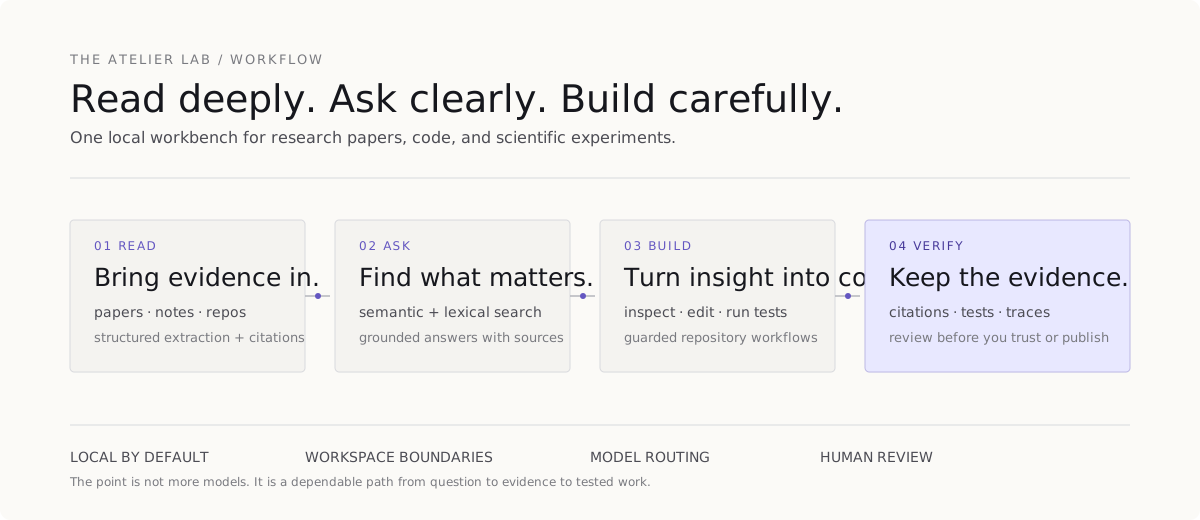
The daily loop starts with a local library of papers, notes, and code. Semantic retrieval finds related ideas, while lexical retrieval preserves exact names and terms. The resulting context supports grounded questions and paper analysis; citations and workflow traces let the researcher return to the evidence behind an answer.

The research workbench · ingest, retrieve, act, verify

The research workbench · ingest, retrieve, act, verify

The workflow connects document ingestion with retrieval, grounded reasoning, tools, and verification. It shows where evidence and checks enter the daily research loop.

A small, frozen evaluation suite

17/18

knowledge answers correct

13/13

code tasks solved

10/10

combined tasks solved

These suites are modest and mostly single-file. They do not establish reliability across entire repositories.

From reading to doing

Tools that close the loop.

Build mode · inspect, edit, test, review

Build mode · inspect, edit, test, review

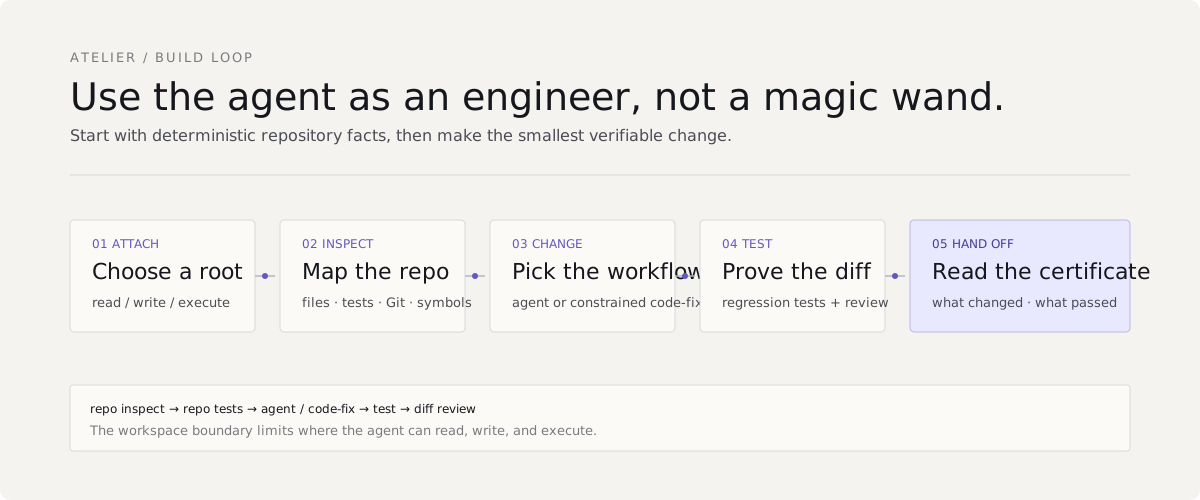
The build loop makes inspection, edits, and tests distinct steps. Its output includes reviewable changes and a verification record rather than only a model’s claim that a task succeeded.

Local model and tool architecture

Local model and tool architecture

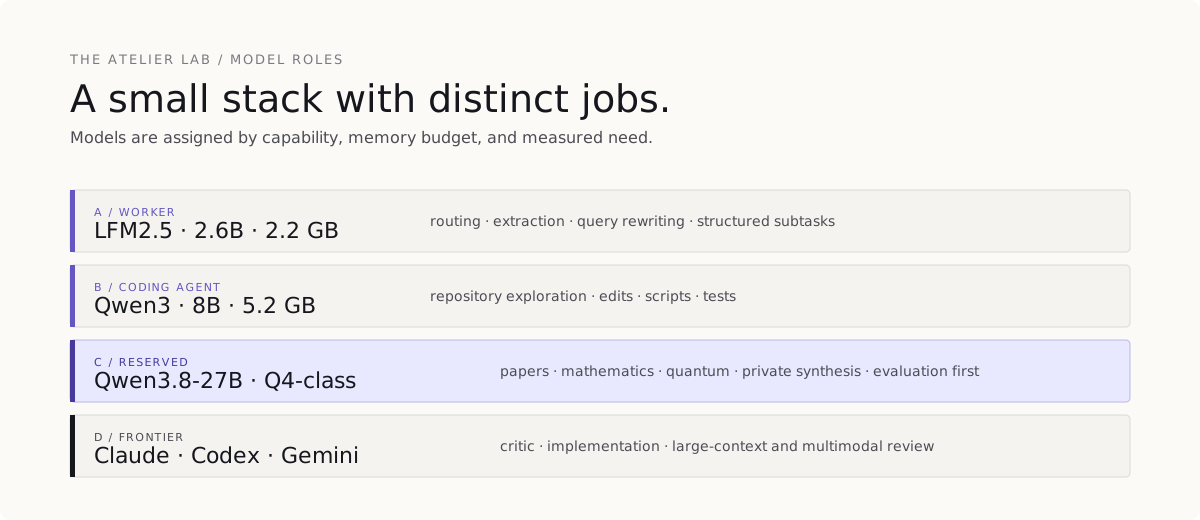
The model stack separates routing, retrieval, and specialist tools. This allows capabilities and latency to be investigated as components instead of treating every task as a single large-model call.

Model experiments & historical training baselines

Local Q4_K_M inference on an M3 Pro with 36 GB RAM measures 39.3 tok/s for qwen3:4b, 11.5 tok/s for qwen3:14b, and 27.9 tok/s for gemma4:26b.

Historical nanochat runs compare 73.5M and 286.2M parameter models at 5,000 steps. The larger model improves validation BPB while reducing throughput.

Historical nanochat baselines · 5,000 steps · lower BPB is better
ParametersThroughput (tok/s)Validation BPB
73.5M≈18,7001.1664
286.2M≈4,4701.0954

The evaluation suites are modest, frozen, and mostly single-file; they do not establish repository-scale reliability. The foundation numbers describe historical nanochat runs, not the educational minillm implementation. This preview also reflects the newer local workbench documentation.

Retrieval, model routing & build verification

A workbench organized around evidence

The daily loop starts with a local library of papers, notes, and code. Semantic retrieval finds related ideas, while lexical retrieval preserves exact names and terms. The resulting context supports grounded questions and paper analysis; citations and workflow traces let the researcher return to the evidence behind an answer.

From an answer to a verified action

Build mode extends this loop to repository inspection, constrained edits, tests, and diff review. Scientific tools provide deterministic circuit inspection and optimization checks alongside language-model reasoning. Model training, inference benchmarks, and the educational implementation remain separate research tracks so their results are not conflated.

Implementation & checks

  1. Ingest documents and source code into a local library with page-aware extraction.
  2. Retrieve semantic and lexical evidence, route the task to a local model, and retain citations and workflow traces.
  3. Verify build tasks with tests and diff review; keep scientific inspection and optimization validation deterministic.